Water Softeners and Filtration Systems in Canyon Lake
Trusted water softeners and filtration systems in Canyon Lake, CA. Licensed and insured plumbing and HVAC pros, upfront pricing. Call (951) 344-5596.
Our technicians are dispatched from our Corona, CA headquarters and are typically on-site in Canyon Lake within 60 minutes of your call.
Canyon Lake’s water supply draws from the Colorado River Aqueduct via the Eastern Municipal Water District, and the result is some of the hardest tap water in Riverside County, mineral loads that leave chalky rings in toilets, shorten water heater life, and turn shower glass cloudy within weeks of cleaning. If you’ve noticed soap that won’t lather properly or a faint metallic taste from the kitchen faucet, the water itself is the culprit, not your fixtures. RT Olson Plumbing, Heating and Air Conditioning installs water softeners, whole-house filtration systems, and reverse osmosis units sized for Canyon Lake homes and available around the clock.
Why Canyon Lake Homes See Hard Water Damage Faster Than Most
Hardness levels in the Eastern Municipal Water District service area regularly run well above the threshold where scale buildup becomes a maintenance problem. That mineral-rich water moves through every appliance connected to your supply line, dishwashers, ice makers, tankless water heaters, and washing machines all accumulate scale on internal components over time. In Canyon Lake’s warm, dry climate, evaporation accelerates the problem: water sitting in pipes during the heat of the day concentrates minerals before it ever reaches your tap.
Homes built on the hillsides surrounding Canyon Lake often use recirculating hot water systems to manage the long pipe runs from the water heater to distant bathrooms. Those loops are especially vulnerable to scale, because hot water holds dissolved minerals less effectively than cold, the moment temperature rises, calcium and magnesium precipitate out and begin coating pipe walls and heat exchanger surfaces. A properly sized ion-exchange water softener interrupts that cycle before it shortens the life of expensive equipment.
Our Water Treatment Process in Canyon Lake
Every installation starts with an on-site water test. We measure hardness (in grains per gallon), total dissolved solids, pH, and any secondary concerns like chloramine levels, Eastern Municipal uses chloramines rather than free chlorine for disinfection, and standard carbon filters don’t remove chloramines as effectively as catalytic carbon media does. That test result drives every equipment recommendation we make.
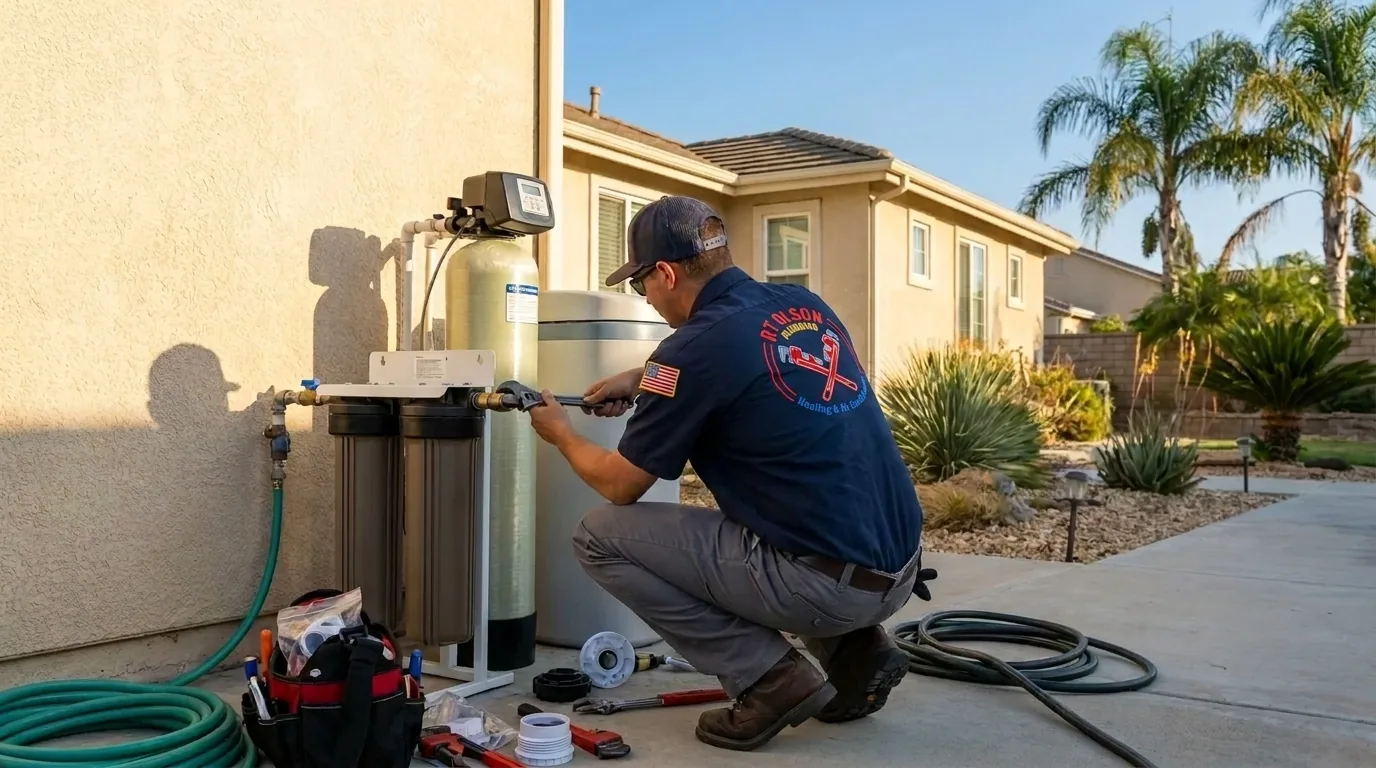
For most Canyon Lake households, the solution is a two-stage approach: a salt-based ion-exchange softener on the main supply line to handle hardness, paired with a catalytic carbon whole-house filter to address taste and chloramine. Homes where drinking water quality is the priority often add an under-sink reverse osmosis system at the kitchen faucet, which takes TDS down to near-zero for cooking and drinking without softening every gallon that flows to the garden hose.
Installation typically requires a bypass valve, a drain connection for the softener’s regeneration cycle, and a dedicated electrical outlet if the unit uses a digital control head. We pull the necessary permits through Riverside County Building and Safety and schedule the inspection so you don’t have to coordinate it yourself.
Equipment and Methods We Use for Water Treatment
We work with metered-demand softeners rather than timer-based units, metered systems regenerate only when the resin bed is actually exhausted, which uses less salt and less water than a clock-driven system regenerating on a fixed schedule regardless of actual usage. In a community like Canyon Lake where water conservation is a real concern, that efficiency matters.
For filtration, catalytic carbon is the media of choice when Eastern Municipal’s chloramine treatment is a factor. Standard activated carbon reduces free chlorine well but struggles with the chloramine bond; catalytic carbon breaks that bond reliably. Whole-house sediment pre-filters upstream of both the softener and the carbon filter extend media life and protect the softener resin from fine particulate that can foul it prematurely.
Reverse osmosis systems we install use a minimum four-stage configuration: sediment pre-filter, carbon block, RO membrane, and post-carbon polishing filter. We size the storage tank to match household demand so you’re not waiting for the tank to refill mid-cooking.
Local Note
Canyon Lake is a private, gated community, and that HOA structure affects service calls in a practical way: access through the main gate requires a valid contractor’s license on file with the community’s security team. RT Olson holds California Contractor’s License #997337, and we’re familiar with the gate check-in process, we bring the documentation needed to clear security without delay so the job starts when we arrive, not after a wait at the guardhouse. If you’re scheduling a non-emergency installation, a quick call to the HOA office ahead of time to add us to the visitor list keeps things moving smoothly.
Call RT Olson Plumbing, Heating and Air Conditioning at (951) 344-5596 any time, we’re available around the clock, to schedule a water test and get a straight answer on what Canyon Lake’s water supply is actually doing to your plumbing and appliances.
Serving Canyon Lake from our Corona headquarters — ★ 4.9 · 621 Google reviews
“RT OLSON have always been on time and have always done clean work. They did a great job installing my water filtration system” — Boota, October 2026Read our reviews on Google →
Water Softeners and Filtration Systems in Canyon Lake: Service Coverage
Frequently Asked Questions
How fast can you arrive for water softeners and filtration systems in Canyon Lake?
How hard is Canyon Lake's water, and is it bad enough to warrant a softener?
Does Canyon Lake's HOA or gate access affect how a water softener installation works?
Why does my Canyon Lake home go through water heater elements and dishwasher components faster than expected?
Will a standard carbon filter handle the taste and odor issues in Canyon Lake's tap water?
How long does a water softener or whole-house filtration installation take in a Canyon Lake home?
Will my homeowners insurance cover water softeners and filtration systems in Canyon Lake?
Water Softeners and Filtration Systems response in Canyon Lake
Most Canyon Lake calls see a technician on-site within 60 minutes from our Corona headquarters.
Nearby & Related
- Water Softeners and Filtration Systems in Corona
- Plumbing, Heating and Air in Canyon Lake
- Air Conditioning Repair in Canyon Lake
- Drain Cleaning in Canyon Lake
- Water Softeners and Filtration Systems in Anaheim
- Water Softeners and Filtration Systems in Bloomington
- Contact RT Olson Plumbing, Heating and Air Conditioning